
Great event lighting does more than make a venue brighter. It can influence how guests move through a space, how photographs look, how decorations are perceived and whether the overall atmosphere feels relaxed, elegant, energetic or professional. Yet choosing the right setup can be surprisingly difficult when you are working with an unfamiliar venue, limited power access or a specific event theme. This guide explains what to consider when arranging event lighting hire in Bendigo, with practical advice for weddings, birthdays, corporate functions and outdoor celebrations.
Lighting is often one of the last elements people think about when planning an event. Furniture, catering, entertainment and decorations usually receive attention first. However, lighting can affect how all those elements look once guests arrive.
A beautifully decorated room can feel flat under harsh overhead lights, while a relatively simple venue can become warm and inviting with carefully positioned ambient lighting. The objective is not necessarily to make every corner equally bright. Good event lighting creates layers, highlights important areas and supports the mood you want guests to experience.
For example, a Bendigo wedding reception may benefit from warm ambient lighting around dining tables, subtle uplighting around walls and softer illumination near the dance floor. A birthday celebration might require brighter, more energetic lighting around the entertainment area while keeping seating zones comfortable and inviting.
This is why Event Lighting Hire in Bendigo should be approached as part of the event design rather than simply as equipment hire.
Before choosing equipment, consider what each type of lighting is actually designed to achieve. There is no single lighting setup that works equally well for every venue or event.
Ambient lighting provides the general illumination guests need to move around, talk and dine comfortably. Depending on the venue, existing ceiling lights may provide some of this illumination, but they are not always visually appealing or suitable for the atmosphere you want.
Additional ambient fixtures can soften a room and create a more cohesive appearance. Warm-toned lighting is particularly popular for evening celebrations because it can make a venue feel more intimate without making it excessively dark.
Decorative lighting is primarily concerned with appearance. This may include illuminated backdrops, festoon-style arrangements, fairy lights, feature lamps or carefully positioned fixtures that draw attention to architectural details.
Feature lighting can be particularly useful when a venue has a plain wall, exposed structure or large unused area that needs visual interest.
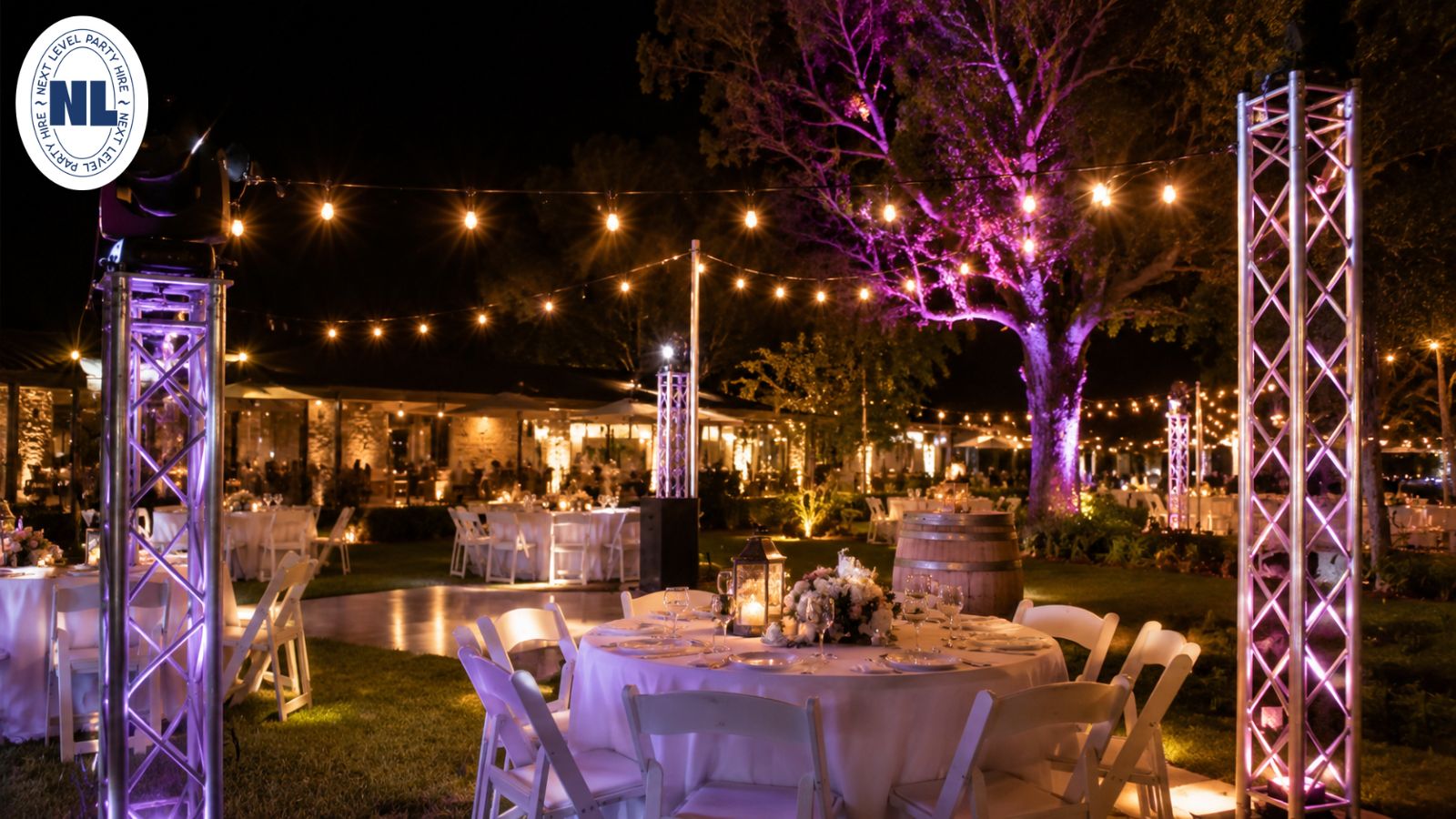
Uplighting places fixtures near the floor and directs light upwards onto walls, curtains or architectural features. It can introduce depth and colour without taking up significant floor space.
Wall washing works on a similar principle but is generally intended to distribute light more evenly across a larger surface. These techniques can make a venue feel more polished while complementing the event’s colour palette.
The right setup depends heavily on what guests will actually be doing during the event. A wedding, birthday and business function may all take place in the same venue but require very different lighting strategies.
When considering wedding lighting hire, think about the entire flow of the reception rather than focusing only on the dance floor.
Dining areas usually benefit from comfortable, flattering illumination that allows guests to see their meals and communicate easily. The entrance, bridal table, cake table and other important visual features may require additional accent lighting.
The dance floor is different. It can support more dynamic lighting because guests expect the atmosphere to become livelier later in the evening. However, overly bright or rapidly changing lights can become distracting, particularly during speeches and dinner.
A practical approach is to divide the venue into lighting zones:
This allows the lighting to change naturally as the event progresses.
For birthdays, anniversaries, engagement parties and similar celebrations, party lighting hire in Bendigo customers may want a more energetic visual environment.
Colour-changing LED fixtures can be useful because the lighting can be adjusted as the party moves from dinner and conversation into dancing. Moving effects may also work well for larger venues, although they are not always necessary for smaller gatherings.
A common mistake is using too many different lighting effects. A few coordinated fixtures can create a stronger result than filling the room with unrelated colours and patterns.
Consider the party theme, venue size, age group and entertainment before selecting equipment.
LED lighting hire in Bendigo has become a practical choice for many modern events because LED fixtures can offer strong illumination while providing flexible colour and intensity options.
LED equipment is particularly useful when a venue needs different lighting moods throughout an event. For example, warm white may be appropriate during dinner, while a more vibrant colour combination can be introduced once dancing begins.
There are also practical considerations. Event lighting equipment must be positioned safely, connected correctly and operated with suitable power distribution. Professional planning matters regardless of whether the fixture uses LED technology or another lighting source.
LED fixtures can provide several useful characteristics for event organisers:
However, LED does not automatically mean better. The quality of the fixture, beam angle, colour rendering, positioning and control system still influence the final result.
Outdoor events introduce additional challenges that indoor venues do not have. When planning outdoor lighting for parties, consider darkness, weather, uneven surfaces, guest movement and access to suitable power.
Outdoor lighting should serve both atmosphere and practicality. Paths, steps, entrances and changes in ground level should be adequately visible. Decorative lighting can then be added around dining areas, marquees, entertainment zones and other features.
Weather is another important consideration. Equipment intended for indoor use should not automatically be assumed to be suitable outdoors. Ask about the equipment’s intended environment and how it should be protected from moisture.
An outdoor lighting plan should consider:
A lighting setup that looks excellent at 5 pm may not provide enough practical illumination at 9 pm. Always consider how the space will change as natural light disappears.
Venue characteristics should influence the lighting plan from the beginning. A large open hall may need a combination of ambient, decorative and feature lighting, while a smaller function room may require only a few carefully positioned fixtures.
Pay attention to ceiling height, wall colour, existing lighting, windows, reflective surfaces and available floor space.
Dark walls can absorb considerable light, meaning more output may be required to achieve the same visual effect. Pale walls and ceilings can reflect light more effectively, sometimes allowing a softer setup to produce a strong result.
It is also worth considering what will appear in photographs. A lighting setup that looks attractive to the naked eye may create unwanted shadows or overly bright backgrounds for photography.
More equipment does not necessarily produce a better event.
The correct amount depends on the venue’s dimensions, existing lighting, guest numbers, event format, desired atmosphere and areas requiring illumination. A small birthday gathering might only need several decorative fixtures and ambient lighting, while a large wedding reception could require multiple lighting zones.
When discussing lighting hire, provide as much venue information as possible. Floor plans, photographs and details about existing fixtures can help determine what is appropriate.
If possible, identify:
This information makes the planning process more accurate and can help avoid paying for equipment that does not contribute meaningfully to the event.
Existing lights are useful, but they may have been designed for general building use rather than atmosphere. Fluorescent or cool overhead lighting can sometimes make an evening event feel more like a workplace than a celebration.
Instead of automatically switching everything off, consider whether the existing lights can be reduced or combined with additional fixtures.
A dance floor should feel energetic, but guests generally do not want intense illumination shining directly into their eyes. Lighting should support the entertainment rather than compete with it.
Decorative lighting should never obstruct walkways or create trip hazards. Cable management, fixture placement and access routes need to be considered before guests arrive.
Colour can transform an event, but excessive colour combinations can make the venue visually confusing. A coordinated palette generally looks more sophisticated than several unrelated colours competing for attention.
Photographers need predictable, balanced illumination. Very dark areas combined with extremely bright fixtures can make exposure difficult and produce unflattering results.
An experienced lighting approach starts with the event experience rather than the equipment list.
Create lighting zones. Treat the venue as a collection of spaces with different purposes. Dining, dancing, speeches and entrances do not need identical illumination.
Plan for the timeline. Lighting should work at the beginning of the event, during dinner and later in the evening. If possible, establish how the lighting will transition between these stages.
Prioritise faces. Guests need enough flattering light to see one another. Decorative effects should not completely replace useful illumination.
Use lighting to direct attention. Important areas such as a stage, cake table or dance floor can receive slightly stronger or more focused lighting.
Check the venue before finalising the setup. Photographs are useful, but an on-site assessment can reveal ceiling restrictions, power limitations, access issues and surfaces that behave differently than expected.
Think about control. Being able to adjust brightness, colour or lighting zones can be more valuable than simply having a large number of fixtures.
Choosing lighting is ultimately about creating the right environment for the people attending your event. The most effective setup is not necessarily the most expensive or equipment-heavy. It is the one that complements the venue, supports the event schedule, keeps important areas visible and creates an atmosphere that feels intentional.
Whether you are organising a wedding, private celebration, corporate function or outdoor gathering, Event Lighting Hire in Bendigo can be approached as part of the overall event design rather than an afterthought. Consider the venue, guest experience, photography, safety and timing before deciding what equipment you need.
For local event organisers who want to explore practical options, Next Level Party Hire can be part of the planning conversation. The best approach is to discuss the event requirements, venue conditions and desired atmosphere first, then select lighting that genuinely suits the occasion rather than simply adding equipment for the sake of it.
There is rarely one universally best option. A layered approach normally works well, combining comfortable ambient lighting with decorative or feature lighting. Warm white illumination can create an inviting dining environment, while adjustable LED fixtures can add colour or movement later in the evening. The venue, wedding style, photography requirements and entertainment should all influence the final selection.
For popular dates, it is sensible to discuss lighting requirements well before the event rather than waiting until the final stages of planning. Earlier planning gives you more opportunity to assess the venue, coordinate lighting with decorations and entertainment, and identify any power or access issues. It also makes changes easier if the event layout develops during planning.
Yes, but outdoor use requires appropriate equipment and planning. Fixtures need to be suitable for the environment, and cables must be positioned safely. Weather, moisture, uneven ground, power access and guest movement should all be considered. Decorative lighting should never compromise safe access to entrances, walkways or emergency routes.
Absolutely. LED fixtures can be particularly practical for smaller events because they can provide strong visual impact without requiring a large quantity of equipment. A few well-positioned fixtures can highlight a feature wall, entertainment area or dance floor. The important consideration is choosing equipment appropriate to the room rather than assuming a larger setup will automatically look better.
Start with the venue name, event date, guest numbers, event type, approximate room dimensions and whether the event is indoors or outdoors. Photos or a floor plan can also be extremely useful. Explain which areas matter most, such as the dance floor, dining tables, stage, entrance or outdoor seating. The more practical information you provide, the easier it is to develop a suitable lighting plan.